| 100. | Mistaken For Strangers - The National | ||
| Boxer (2007) | |||
| You could accuse them of being the poor folk's Interpol. But The National have pieced together an impressive body of work over the past decade or so, and this was the standout track from their breakthrough album. It broods like Interpol, and is as lyrically obtuse. The relentless snapping drums set the mood without any real letup as we transition seamlessly into a very nice, understated chorus that somehow manages to be catchy at the same time. | |||
| 99. | The Miller's Daughter - The Drones | ||
| The Miller's Daughter (2005) | |||
| This was a tricky inclusion. There are a number of artists represented here whose body of work has rightly earned them a place in this list, even if they never released a killer hit single during that time, and The Drones presented just such a problem. Lifted from the eponymous EP, this is as snarlingly good as anything the band has ever released, and it captures all their raucus talents - both lyrically and musically. | |||
| 98. | Cattle & The Creeping Things - The Hold Steady | ||
| Separation Sunday (2005) | |||
| Separation Sunday was by this reviewer's reckoning one of the freshest releases of the mid-noughties. It presented a vision of adolescent urban alienation delivered in a vital, engaging, and at times even poetic stream of consciousness monologue. What made the album REALLY interesting was its interplay between urban alienation tales and religious - particularly high Catholic themes. That this is the moral background against which American youth in particular play out their adolescence made Separation Sunday a vital and unique cultural survey which had a lot new to say and said it exceptionally well. And while rock/pop's propensity to steal or to drape itself in religious iconography and mores is indisputable, rarely is this managed with anywhere near the empathy for its content. Separation Sunday instead is a proper exploration of the interplay between identity and religon, particularly during modern adolescence when identity is so much in crisis anyway. Hence the iconography of graffiti and recreational drug use sits everywhere in the album uneasily beside Christian iconography. This interplay is nowhere more redolent than in this track, and it's what really gives this one a dimension of greatness. | |||
| 97. | The Leavers Dance - The Veils | ||
| The Runaway Found (2003) | |||
| It does the soaring tuneful indie sound archetypal of its time as well as any. | |||
| 96. | Atlas - Battles | ||
| Mirrored (2007) | |||
| Certainly one of the more unique of the decade's offerings, and utterly insidious in spite of itself. A real garage jam aesthetic prevails here, the vocals are minimal, as is the content, and that's kind of the point here. It's an exercise in form. And one of the great ones. | |||
| 95. | C'mon C'mon - The Von Bondies | ||
| Pawn Shoppe Heart (2004) | |||
| This was one of the most barnstorming releases of 2004. It grabs you by the scruff of your aural neck within the first thirteen seconds and never lets go. And you're almost dared not to sing along. | |||
| 94. | Gold Digger - Kanye West | ||
| Late Registration (2005) | |||
| This insidious dancefloor mega-hit was played at every party on every scene in 2005, and probably represents the moment we realised Kanye wasn't going away anytime soon. | |||
| 93. | For Reverend Green - Animal Collective | ||
| Strawberry Jam (2007) | |||
| The arch experimenters came into their own in the noughties. Arguably nobody pushed the form of popular song more consistently and artfully across the decade than the Baltimore four-piece. And this swoony, multi-layered cacophany is entirely representative. | |||
| 92. | Fuck Forever - Babyshambles | ||
| Down In Albion (2005) | |||
| At first I wondered "what's the point in having a side project to the Libertines which sounds exactly like them?" But apparently Mr Pete Doherty was actually tossed out of the Libertines for some alleged and no doubt spurious substance abuse issues. And this bare bones, cocaine-addled ode to decadence was a pretty memorable response. | |||
| 91. | Heart Failed (In The Back Of A Taxi) - Saint Etienne | ||
| London Conversations (2000) | |||
| Saint Etienne were truly a nineties act, but they had this one hit in the mature years of their reign that is the equal of anything they ever produced. Easy to put in a genre with Massive Attack, EBTG, Portishead, they never quite achieved the fame or status of those others, but their body of work does stand out well against theirs, and this track shows why. | |||
Thursday, January 28, 2016
Numbers 100 - 91, "for Reverend Green"

Friday, January 15, 2016
Numbers 150 - 126, "Kill All Hippies"
The plural of medium is media.
And the noughties have offered a proliferation of previously unimaginable channels for the production and distribution of music that have been tantamount to a revolution in the entire way music is communicated. And if music is little else than a vehicle for communication, then this is a revolution in the very essence of the medium.
What does it mean that anyone with an internet connection can stream almost at will practically ANY song from the ENTIRE body of human recorded history? And this is neither much of an exaggeration nor any real extrapolation. The Alan Lomax recordings are all on Spotify now.
Does this mean that we are set to witness the death of recorded music as a physical object? A casual look at the sorts of prices collectible vinyl still goes for would suggest no. In fact the other real trend we saw in the noughties was the resurgence of vinyl as a fetishised object, wherein it has connotations of authenticity and of connoisseurship. Values that rock/pop ideology has always valorised in its heirarchies in contrasting the 'commercial' with the 'authentic'.
But as we'll see in the next installment, what the noughties have done is blur that boundary between commercial and authentic. Since the days when Biz Markie first 'yes y'all'-ed forth, hip hop music has had its aim squarely on destroying this dialectic. The accumulation of bling actually became your route to authenticity, not its opposite. And any casual look particularly at contemporary music video culture shows how quickly discourses from this arena have become pop culture stereotypes.
Five minutes on any given Video Hits channel trammels up a bewildering array of variously rehashed stereotypes that owe considerably more to cheerleading and other communal dance activities than they do to a popular music heritage that runs all the way back to the 1950s.
So here we are in the perpetual now, shorn of our history and all its context. Naked and unformed whiteboards waiting to be scribbled on and erased, where we have NO BASIS for attaching quaint, unitary, historicity to anything, where any value judgement is subjective - can never be definitive. By definition that can never be defined either.
It should really be no wonder that in this environment political music died a sorry death. And Neil Young, the already dead, is the only fellow in today's list who could conjure its true spirit. #146, below. Enjoy.
And the noughties have offered a proliferation of previously unimaginable channels for the production and distribution of music that have been tantamount to a revolution in the entire way music is communicated. And if music is little else than a vehicle for communication, then this is a revolution in the very essence of the medium.
What does it mean that anyone with an internet connection can stream almost at will practically ANY song from the ENTIRE body of human recorded history? And this is neither much of an exaggeration nor any real extrapolation. The Alan Lomax recordings are all on Spotify now.
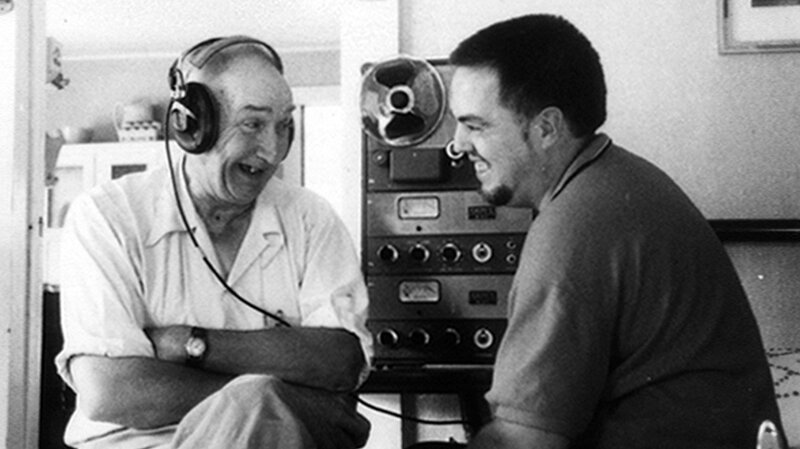 |
| Alan Lomax (r) with Wade Ward, 1959-60 |
But as we'll see in the next installment, what the noughties have done is blur that boundary between commercial and authentic. Since the days when Biz Markie first 'yes y'all'-ed forth, hip hop music has had its aim squarely on destroying this dialectic. The accumulation of bling actually became your route to authenticity, not its opposite. And any casual look particularly at contemporary music video culture shows how quickly discourses from this arena have become pop culture stereotypes.
Five minutes on any given Video Hits channel trammels up a bewildering array of variously rehashed stereotypes that owe considerably more to cheerleading and other communal dance activities than they do to a popular music heritage that runs all the way back to the 1950s.
So here we are in the perpetual now, shorn of our history and all its context. Naked and unformed whiteboards waiting to be scribbled on and erased, where we have NO BASIS for attaching quaint, unitary, historicity to anything, where any value judgement is subjective - can never be definitive. By definition that can never be defined either.
It should really be no wonder that in this environment political music died a sorry death. And Neil Young, the already dead, is the only fellow in today's list who could conjure its true spirit. #146, below. Enjoy.
| 150. | Motorbike | Wooden Shjips | Dos (2009) |
| 149. | Track Of The Cat | Pram | Dark Island (2003) |
| 148. | This Is Hardcore | Pulp | Hits (2006) |
| 147. | Monster | You Say Party! We Say Die! | Lose All Time (2007) |
| 146. | Flags Of Freedom | Neil Young | Living With War (2006) |
| 145. | Welcome to Jamrock | Damian Marley | Reggae Mix (2004) |
| 144. | Dream On | Christian Falk Ft. Robyn | Dream On (2008) |
| 143. | Playground Love | Air | Talkie Walkie (Russian Edition W/Bonus) (2003) |
| 142. | Do You Want To- | Franz Ferdinand | (2005) |
| 141. | Ha | HTRK | Marry Me Tonight (2009) |
| 140. | Bonkers | Dizzee Rascal | Tongue N' Cheek (2009) |
| 139. | Sing It Back | Moloko | Things To Make And Do (2000) |
| 138. | Smile Like You Mean It | The Killers | Hot Fuss (2004) |
| 137. | Bottle Baby | Augie March | Moo, You Bloody Choir (2006) |
| 136. | Dare | Gorillaz | Dare (2005) |
| 135. | 1 Thing | Amerie | P (2008) |
| 134. | Tear You Apart | She Wants Revenge | She Wants Revenge (2006) |
| 133. | Hard To Explain | The Strokes | Is This It? (2000) |
| 132. | Kill All Hippies | Primal Scream | Xtrmntr (2000) |
| 131. | No One Does It Like You | Department Of Eagles | In Ear Park (2008) |
| 130. | Take Me Out | Franz Ferdinand | Franz Ferdinand (2004) |
| 129. | Come Pick Me Up | Ryan Adams | Heartbreaker (2000) |
| 128. | Island In The Sun | Weezer | The Green Album (2001) |
| 127. | Dominos | The Big Pink | A Brief History Of Love (2009) |
| 126. | Spaceape | Burial Feat. The Space Ape | Burial (2006) |
Numbers 125 - 101, "Jesus, etc."
So what's the point of it all? In an age when everything is fragmented and personalised to the nth degree, what's the point of trying to maintain a pantheon, a heirarchy, a 'Top Forty' anything?
We're all going to have umpteen variants of this same pantheon. What I've done here, in spite of the professed objectivity of my method, is produce a list that is irredeemably my own, and unavoidably incomplete. I can't have heard every song that would conceivably qualify for this last, and where that mightn't have mattered doing this for the eighties or nineties because the candidates at least for the upper echelons would be pretty incontrovertible.
But THE noughties artist? I laugh a little under my breath when I hear people debating Foals v Muse v ColdPlay v Franz Ferdinand. Most of these artists don't make this chart. By virtue of not being good enough to even be candidates. So the Pantheon, if it even vaguely exists is completely in dispute and completely individualised. Radiohead would probably be as close to a universal nomination as you could go.
And as we've seen, this process leads directly to a shifting in locus for any Pantheon from the trans-generic realm of "pop/rock" into the specifically genre-based R&B/club arena. So in this list we do hear quite a bit from Beyonce and Jay-Z, Alicia Keys and Kanye. Heck, I've even got the Sugababes in this installment.
Because you certainly earn credit in this reviewer's accounts for taking YOUR form, ANY form, no matter now hackneyed, outdated or conservative, and re-working that form to its artistic acme. Music today has a far broader and more significant social function than when the classical composers built its original pantheon.
As we've seen, the idea that music might be able to change the world in some monolithic manner might be dead, but our belief that developing new ways of seeing the world, of "innovating" (pardon me, I'm trying to be zeitgeisty) our entire outlook being central to humanity's future dies much harder.
And so I'll keep pumping this out, for it maps something far more significant and more resonant than an agreeable collection of sounds. It's the heartbeat of the ages.
We're all going to have umpteen variants of this same pantheon. What I've done here, in spite of the professed objectivity of my method, is produce a list that is irredeemably my own, and unavoidably incomplete. I can't have heard every song that would conceivably qualify for this last, and where that mightn't have mattered doing this for the eighties or nineties because the candidates at least for the upper echelons would be pretty incontrovertible.
But THE noughties artist? I laugh a little under my breath when I hear people debating Foals v Muse v ColdPlay v Franz Ferdinand. Most of these artists don't make this chart. By virtue of not being good enough to even be candidates. So the Pantheon, if it even vaguely exists is completely in dispute and completely individualised. Radiohead would probably be as close to a universal nomination as you could go.
And as we've seen, this process leads directly to a shifting in locus for any Pantheon from the trans-generic realm of "pop/rock" into the specifically genre-based R&B/club arena. So in this list we do hear quite a bit from Beyonce and Jay-Z, Alicia Keys and Kanye. Heck, I've even got the Sugababes in this installment.
 |
| The Sugababes - Lineup #638,742 Mutya/Keisha/Siobhan |
As we've seen, the idea that music might be able to change the world in some monolithic manner might be dead, but our belief that developing new ways of seeing the world, of "innovating" (pardon me, I'm trying to be zeitgeisty) our entire outlook being central to humanity's future dies much harder.
And so I'll keep pumping this out, for it maps something far more significant and more resonant than an agreeable collection of sounds. It's the heartbeat of the ages.
| 125. | Dear Catastrophe Waitress | Belle and Sebastian | Dear Catastrophe Waitress (2003) |
| 124. | Rej | Âme | Rej (2006) |
| 123. | Fuck the Poor | Selfish Cunt | No Wicked Heart Shall Prosper (2004) |
| 122. | I Want To Die In The Hot Summer | I Love You But I've Chosen Darkness | I Love You But I've Chosen Darkness [EP] (2003) |
| 121. | Jesus, Etc. | Wilco | From the Beginning (2007) |
| 120. | My Little Brother | Art Brut | Bang Bang Rock & Roll (2005) |
| 119. | Cruiser | Red House Painters | Old Ramon (2001) |
| 118. | Fix Up, Look Sharp | Dizzee Rascal | Boy In Da Corner () |
| 117. | Bloody Mother Fucking Asshole | Martha Wainwright | Martha Wainwright (2005) |
| 116. | Young Folks | Peter Bjorn and John | Writer's Block (2006) |
| 115. | Jerk It Out | The Caesars | 39 Minutes Of Bliss (2003) |
| 114. | Seven Nation Army | The White Stripes | Elephant (2003) |
| 113. | Decent Days And Nights | The Futureheads | Burnout 3 : Takedown (2004) |
| 112. | Daft Punk Is Playing At My House | LCD Soundsystem | LCD Soundsystem [Disc 1] (2005) |
| 111. | Heartbeat And Sails | Augie March | Sunset Studies (2001) |
| 110. | Slow Hands | Interpol | Antics (2004) |
| 109. | Follow The Cops Back Home | Placebo | Meds (2006) |
| 108. | Black Rainbow | St. Vincent | Actor (2009) |
| 107. | Eli, The Barrow Boy | The Decemberists | Picaresque (2005) |
| 106. | Two Weeks | Grizzly Bear | Veckatimest (2009) |
| 105. | No One | Alicia Keys | As I Am (2007) |
| 104. | Feel Good Inc. | Gorillaz | Dare (2005) |
| 103. | Scarlet Fields | The Horrors | Primary Colours (2009) |
| 102. | Push The Button | Sugababes | Change (2000) |
| 101. | Waitin' For A Superman | The Flaming Lips | VOID [Video Overview In Deceleration] [Music] (2005) |
Monday, January 11, 2016
Numbers 175 - 151, "I'll Believe in Anything"
What else made the noughties what it was? We've spoken briefly already about stylistic fragmentation in noughties music, about the lack of distinct new musical 'styles' the decade produced.
What is going on here? It's postmodernism's essence to plunder pre-existing styles and forms. It is drawn from a sense of being beyond the "end of history", human recorded history being large and established enough now to create a sense that all possible things have already happened, all possible genres and discourses have already established. There is nothing new or original left to say. The 12 notes in the Western musical register have already been combined in every possible way.
But this is a decade which proved all this something of a falsehood. The decade began with the planet agape in horror at the events of September 11, 2001. And if this wasn't a new form of history playing out before our box-fixed eyes, then the whole thing was just another live TV drama.

But if the event itself seemed to buck postmodernity, the manner in which it was experienced by a sizeable portion of the planet in real time video, was resolutely postmodern. And the nature of the attacks themselves again underscore this, in which the very acme of modernity's technological achievements are turned into weapons against modernity, against technological advancement, against human advancement altogether.
So, we are more integrated as a species than ever before. More so than ever we can now experience phenomena/media/disourses that take place in cultures, societies and geographies far removed from our own and create a simulacra effect of the same phenomena as though they were OUR lived experiences.
And the music market, even with the fragmentation new technology has brought, is more global than ever. It's very difficult to imagine a band like Tame Impala having the same opportunities to make it globally under the old industry distribution and marketing models.
Bands like The Birthday Party and The Go-Betweens in the 80s HAD to leave Australia to access the global music market. Today that would be a very unusual decision for a band to make.
There's a question here of what fragmentation actually means, particularly given that technology has enabled music's fragmentation in line with heightened individualisation. Social media, streaming services, torrents, YouTube, Rate Your Music, Tune-Up, Last.fm, these are all geared towards allowing people to seek out any song on demand and display their individual proclivities in public.
And consequently, we've seen this decade LESS dominated by the sorts of blockbuster acts like U2, and the acts that have emerged form a FAR less established critical hierarchy than any prior decade. Ask five people to name the top five artists of the decade and I'd wager you'd have a list of twenty five separate artists.
And every individual now has a new technology route to getting their music published and distributed wholly absent of any record company organisation, or indeed without a lot of the costs associated with older physical distribution models.
So we've seen a levelling of the playing field, a democratisation of access to the medium, at the same time as the profitability of the formal organisations like record companies has plummeted. It's difficult to be too pessimistic about this, but it does leave one wondering whether, in the absence of the historical "common spaces" where we used to experience music communally and similarly, whether music's social function is going to be impaired.
Because heirarchies provide a means for individuals to communally debate particular discourses with reference to a common starting language. So people with vastly different lived experiences of jazz can all still debate "the greatest jazz track ever".
What happens if and when we lose all sense of our common lived experiences? Can music still continue advancing as a form if every newly empowered individual is working in their own isolated universe?
Because look at what's happened to the Top Forty charts over the course of the decade. Slowly the charts have basically become a virtual proxy for the R&B/dance charts. And why? Where, in the pantheon of noughties experience, is the one place we all still go to hear music in a communal setting? It's the club.
So, club music is the only form capable of pitching to the undifferentiated entire larger music market, and becomes the universal musical language. And that's a problem. Because it's mostly awful, artless, self-aggrandising dross.
What is going on here? It's postmodernism's essence to plunder pre-existing styles and forms. It is drawn from a sense of being beyond the "end of history", human recorded history being large and established enough now to create a sense that all possible things have already happened, all possible genres and discourses have already established. There is nothing new or original left to say. The 12 notes in the Western musical register have already been combined in every possible way.
But this is a decade which proved all this something of a falsehood. The decade began with the planet agape in horror at the events of September 11, 2001. And if this wasn't a new form of history playing out before our box-fixed eyes, then the whole thing was just another live TV drama.

But if the event itself seemed to buck postmodernity, the manner in which it was experienced by a sizeable portion of the planet in real time video, was resolutely postmodern. And the nature of the attacks themselves again underscore this, in which the very acme of modernity's technological achievements are turned into weapons against modernity, against technological advancement, against human advancement altogether.
So, we are more integrated as a species than ever before. More so than ever we can now experience phenomena/media/disourses that take place in cultures, societies and geographies far removed from our own and create a simulacra effect of the same phenomena as though they were OUR lived experiences.
And the music market, even with the fragmentation new technology has brought, is more global than ever. It's very difficult to imagine a band like Tame Impala having the same opportunities to make it globally under the old industry distribution and marketing models.
Bands like The Birthday Party and The Go-Betweens in the 80s HAD to leave Australia to access the global music market. Today that would be a very unusual decision for a band to make.
There's a question here of what fragmentation actually means, particularly given that technology has enabled music's fragmentation in line with heightened individualisation. Social media, streaming services, torrents, YouTube, Rate Your Music, Tune-Up, Last.fm, these are all geared towards allowing people to seek out any song on demand and display their individual proclivities in public.
And consequently, we've seen this decade LESS dominated by the sorts of blockbuster acts like U2, and the acts that have emerged form a FAR less established critical hierarchy than any prior decade. Ask five people to name the top five artists of the decade and I'd wager you'd have a list of twenty five separate artists.
And every individual now has a new technology route to getting their music published and distributed wholly absent of any record company organisation, or indeed without a lot of the costs associated with older physical distribution models.
So we've seen a levelling of the playing field, a democratisation of access to the medium, at the same time as the profitability of the formal organisations like record companies has plummeted. It's difficult to be too pessimistic about this, but it does leave one wondering whether, in the absence of the historical "common spaces" where we used to experience music communally and similarly, whether music's social function is going to be impaired.
Because heirarchies provide a means for individuals to communally debate particular discourses with reference to a common starting language. So people with vastly different lived experiences of jazz can all still debate "the greatest jazz track ever".
What happens if and when we lose all sense of our common lived experiences? Can music still continue advancing as a form if every newly empowered individual is working in their own isolated universe?
Because look at what's happened to the Top Forty charts over the course of the decade. Slowly the charts have basically become a virtual proxy for the R&B/dance charts. And why? Where, in the pantheon of noughties experience, is the one place we all still go to hear music in a communal setting? It's the club.
So, club music is the only form capable of pitching to the undifferentiated entire larger music market, and becomes the universal musical language. And that's a problem. Because it's mostly awful, artless, self-aggrandising dross.
| 175. | Lover's Spit | Broken Social Scene | You Forgot It In People (2002) |
| 174. | Welcome, Ghosts | Explosions In The Sky | All Of A Sudden I Miss Everyone (2006) |
| 173. | Beautiful Life | Gui Boratto | Chromophobia (2007) |
| 172. | Welfare Bread | King Khan & The Shrines | What Is?! (2007) |
| 171. | Requiem for Dying Mothers, Part 2 | Stars Of The Lid | The Tired Sounds of Stars of the Lid (2004) |
| 170. | I'll Believe In Anything | Wolf Parade | Apologies To The Queen Mary (2005) |
| 169. | Paper Doll | Louis XIV | The Best Little Secrets Are Kept (2005) |
| 168. | All Different Things | Bark Psychosis | Independency (2007) |
| 167. | Fredericia | Do Make Say Think | Winter Hymn Country Hymn Secret Hymn (2003) |
| 166. | The Man With The Red Face | Laurent Garnier | Unreasonable Behaviour (2000) |
| 165. | Velvet | The Big Pink | A Brief History Of Love (2009) |
| 164. | Tiny Cities Made Of Ashes | Sun Kil Moon | Tiny Cities (2005) |
| 163. | Spongebob | Coki | The Sound Of Dubstep Classics - Ministry Of Sound (2007) |
| 162. | Miura | Metro Area | Metro Area (2002) |
| 161. | Love Trinity | Life Without Buildings | Love Trinity EP (2000) |
| 160. | Chicago | Sufjan Stevens | Illinois (2005) |
| 159. | Tracking Treasure Down Featuring Molly | Gabriel and Dresden | Legends 2005 (2005) |
| 158. | Grounds For Divorce | Wolf Parade | Apologies To The Queen Mary (2004) |
| 157. | Small Town Girl | Good Shoes | Think Before You Speak [Bonus Tracks] (2007) |
| 156. | My Angel Rocks Back And Forth | Four Tet | Rounds (2003) |
| 155. | A-Punk | Vampire Weekend | EP (2007) |
| 154. | Irreplaceable | Beyoncé | B' Day (2006) |
| 153. | Neverending Math Equation | Sun Kil Moon | Tiny Cities (2005) |
| 152. | Your Little Hoodrat Friend | The Hold Steady | Separation Sunday (2005) |
| 151. | Zen | Clipse | We Got It 4 Cheap, Vol. 2 (2005) |
Thursday, December 10, 2015
Numbers 200 - 176, "The Teaches of Peaches"
It doesn't take terribly much inspection of the list so far to arrive at a particularly unfortunate conclusion: POLITICAL MUSIC IS DEAD TODAY.
Because there isn't even an otherwise ignored undercurrent of political activism to the contemporary music scene, such as has previously been the case since the 1950s.
In the 80s and 90s, the likes of U2 and Midnight Oil would routinely be presented as overtly "political" music. What's really being measured is the tradition of the "protest song". Bono and the Oils wrote protest music - songs that had an identified target and went for its political jugular.
Today, we have M.I.A., yes, but what's interesting is that the politics has migrated from the song itself and into the sphere of the singer's identity. M.I.A.'s music might reference "third world democracy" before singing "zoom-a-zoom-a-zoom-zoom", but the content is by and large not political, and not message-oriented. And as a sung message anyway, to a certain extent perhaps any statement has to be INHERENTLY trivial, and existentially banal.
Instead, as political activism in general has become more oriented to the personal and the realm of identity politics, so political music has become more discursive. So it's less about the transmission of opposition to 'monolithic others' to be shouted down via slogans and rhetoric, and more about cultural modes of resistance.
Peaches doesn't spend a huge amount of time opining on the discursive practices behind gender. Her lyrics don't celebrate queer cultures in the recognisable and overt way that say the Pet Shop Boys' "Go West" was an overt paean to them. The differene between "Go West" and "Fuck the Pain Away" is obvious from the song titles alone, and it exemplifies quite well the overall change that we are mapping. Peaches doesn't tell folks to go out and join queer collectives. But every element of her SELF, her identity, her persona is imbued with a radical counter-disourse towards some sort of similar EFFECT.
It's the difference between maintaining the illusion of the unitary, immutable power of the word, the truth, that which lends itself to structuralist analysis, and accepting a truly postmodern, discursive analytics. The two prescribe very different modes for effective political action.
And given Midnight Oil and U2 have resolutely failed to change the world through music, I would mount a case that a new, discursive political music stands just as good a chance of achieving something as the old modes we'd more directly recognise.
That said, I, a decrepit socialist find real meaning in connecting with the unitary, barricade-storming ballads that socialists have marched behind for hundreds of years. Billy Bragg, Phil Ochs and Joe Hill offer us a motherlode as historians of political songforms.
And because everything that's wrong with the world today is an inability to grasp the historical context of anything, well, where people stand up for their rights, Joe Hill is with us still. Joe Hill inspires us still.
Because there isn't even an otherwise ignored undercurrent of political activism to the contemporary music scene, such as has previously been the case since the 1950s.
In the 80s and 90s, the likes of U2 and Midnight Oil would routinely be presented as overtly "political" music. What's really being measured is the tradition of the "protest song". Bono and the Oils wrote protest music - songs that had an identified target and went for its political jugular.
Today, we have M.I.A., yes, but what's interesting is that the politics has migrated from the song itself and into the sphere of the singer's identity. M.I.A.'s music might reference "third world democracy" before singing "zoom-a-zoom-a-zoom-zoom", but the content is by and large not political, and not message-oriented. And as a sung message anyway, to a certain extent perhaps any statement has to be INHERENTLY trivial, and existentially banal.
Instead, as political activism in general has become more oriented to the personal and the realm of identity politics, so political music has become more discursive. So it's less about the transmission of opposition to 'monolithic others' to be shouted down via slogans and rhetoric, and more about cultural modes of resistance.
Peaches doesn't spend a huge amount of time opining on the discursive practices behind gender. Her lyrics don't celebrate queer cultures in the recognisable and overt way that say the Pet Shop Boys' "Go West" was an overt paean to them. The differene between "Go West" and "Fuck the Pain Away" is obvious from the song titles alone, and it exemplifies quite well the overall change that we are mapping. Peaches doesn't tell folks to go out and join queer collectives. But every element of her SELF, her identity, her persona is imbued with a radical counter-disourse towards some sort of similar EFFECT.
It's the difference between maintaining the illusion of the unitary, immutable power of the word, the truth, that which lends itself to structuralist analysis, and accepting a truly postmodern, discursive analytics. The two prescribe very different modes for effective political action.
And given Midnight Oil and U2 have resolutely failed to change the world through music, I would mount a case that a new, discursive political music stands just as good a chance of achieving something as the old modes we'd more directly recognise.
That said, I, a decrepit socialist find real meaning in connecting with the unitary, barricade-storming ballads that socialists have marched behind for hundreds of years. Billy Bragg, Phil Ochs and Joe Hill offer us a motherlode as historians of political songforms.
And because everything that's wrong with the world today is an inability to grasp the historical context of anything, well, where people stand up for their rights, Joe Hill is with us still. Joe Hill inspires us still.
| 200. | Night (Radio Edit) | Benga & Coki | Night (2008) |
| 199. | Barely Legal | The Strokes | Is This It? (2000) |
| 198. | Amazing it Seems | Granada | Granada (2005) |
| 197. | Get Myself Into It | The Rapture | Get Myself Into It (Comm Single) (2006) |
| 196. | Strict Machine | Goldfrapp | Black Cherry (2003) |
| 195. | The Orchids | Califone | Roots & Crowns (2006) |
| 194. | The Funeral | Band Of Horses | Everything All The Time (2006) |
| 193. | Rutten | Skream | Skream! [Bonus Tracks] (2006) |
| 192. | Fools | The Dodos | Visiter (2008) |
| 191. | Apocalypse Song | St. Vincent | Marry Me (2007) |
| 190. | C'Mere | Interpol | Antics (2004) |
| 189. | Punchlines | Mates Of State | Bring It Back (2006) |
| 188. | Hang Me Up To Dry | Cold War Kids | Up In Rags [EP] (2006) |
| 187. | Lights Out | Santigold | Santogold (2008) |
| 186. | Ten Years Or Twenty | Moon Wiring Club | Shoes Off And Chairs Away (2009) |
I MADE THIS VIDEO! PRAISE ME! | |||
| 185. | New Slang | The Shins | Oh, Inverted World (2001) |
| 184. | He's Alright [Bonus Track] | Kurt Vile | Childish Prodigy (2009) |
| 183. | Are You The One? | The Presets | Beams (2005) |
| 182. | Pure Pleasure Seeker | Moloko | Things To Make And Do (2000) |
| 181. | Banging Camp | The Hold Steady | Separation Sunday (2005) |
| 180. | Daniel | Bat For Lashes | Two Suns (2009) |
| 179. | Fuck The Pain Away | Peaches | The Teaches Of Peaches (2000) |
| 178. | Thou Shalt Always Kill | Dan Le Sac Vs. Scroobius Pip | Angles (2008) |
| 177. | Try Again | Aaliyah Feat. Timbaland | Aaliyah (2005) |
| 176. | L.E.S. Artistes | Santigold | Santogold (2000) |
Monday, November 2, 2015
Numbers 225 - 201, "Things Fall Apart"
What were the noughties? It's possibly a premature question to ask. Where we had a clear sense of what the previous decade constituted in 1995, we probably had a less clear picture of the 90s in 2005, and an arguably less defined one again in 2015.
So, in one respect the capabilities of a discrete ten year block to connote all of the aesthetic, social and cultural changes within it seem to be declining. And that's possibly part of what we're mapping. There is no question that the seemingly ever-accelerating pace of globalisation along with the rapid technological changes that have enabled it have produced an infinitely more complex world, and complexity is by its nature resistant to essentialism.
Complexity is also resistant to harbouring the sort of regionalisms that prosper behind protectionist walls. Discourse is now at least potentially more global than ever, and it becomes more difficult for regional discourses to exist in isolation from others that don't share a similar regional focus.
And you'd expect all of this to lead to a few things in the musical milieu:
- A more globalised musical culture with less regional differences
- A musical culture based less on discrete styles or genres than around interrogations between those styles
- A musical culture less dominated by a small number of headline artists, and more by an undifferentiated mass body of artists
- A democratisation of the process of music production enabled by advances in home recording technology and new distribution models
The noughties were arguably the first decade which saw no major new music genres emerge. This ties in with concepts a postmodernist would have no trouble at all recognising regarding the 'death of history' and our living in 'an eternal present'. But it also maps a new form of discursive plurality that has perhaps almost come to define the postmodern condition. The inherent intertextuality of all discourse is both highlighted and heightened by the new technologies used for its transmission. So no song exists independent of both the musical discourses that preceeded it, nor similarly the contemporaneous discourses within which all music is received. This would include all economic, political, social, societal, etc discourses.
And it's not surprising a model like that should turn out few new discrete styles and genres, where the production of such depends more upon isolation and an environment in which similar discourses arising from similar inputs have their own discrete chamber within which to reverberate, wholly isolated from the larger body politic.
My thesis is that we've really only seen two significant new musical styles in the last ten years - Grime and Dubstep. Grime is hip hop with the postmodernism turned up to 11. Where hip hop was all about sampling and re-using found objects, it was thoroughly dada-ist in its aesthetic. So, what many posit as the ultimate postmodern musical style is actually thoroughly grounded in an aesthetic that dips its lid more in modernism's direction.
Grime appears to dissipate the entire possibilities of identity. Grime is Dizzee Rascall riffing on the same syncopated rhythm eight lines in a row, eight times the same statement, but with each line producing different meaning. Grime is complex triple-stepping beats where High Modernist Hip Hop just needed a kickdrum on every 4/4 beat.
Where hip hop writes from the position of a vastly over-determined unitary narrator. "I" is the most routinely used word in hip hop lyrics. But that identity has thoroughly broken down in grime. Gone much of the "bitches and bling" bravado, to be replaced by a more humble, more polyvalent, less all-powerful narrative.
Similarly, Dubstep has its origins in drum and bass and allied dance styles. Accordingly, it's almost a completely post-linguistic style. Lyrics are minimal and exist more as just another sonic element. It's in many ways the apotheosis of the post-meaning, post-god, post-discursive style that one would predict emerging, given how many other aspects of contemporary complexity also exhibit these traits.
More on this to come. I thought you'd probably want some actual music in the interim.
| # | Name | Artist | Album (Year) |
| 225. | You Know I'm No Good | Amy Winehouse | Back To Black (2006) |
| 224. | Letter from Abroad | John Cale | (2008) |
| 223. | Skip To The End | The Futureheads | Promo Only Modern Rock June 2006 (2006) |
| 222. | Green Aisles | Real Estate | Days (2011) |
| 221. | 2080 | Yeasayer | All Hour Cymbals (2007) |
| 220. | Postcards From Italy | Beirut | Beirut (2006) |
| 219. | Body Language (Tocadisco Remix) | M.A.N.D.Y. Vs. Booka Shade | Body Language (Single) (2007) |
| 218. | I Feel Space | Lindstrøm | Solid Sounds 2005.2 [Disc 1] (2005) |
| 217. | Knife | Grizzly Bear | Yellow House (2006) |
| 216. | Pass That Dutch | Missy Elliott Feat. Ludacris | Respect M.E. (2003) |
| 215. | Memorize The City | The Organ | Grab That Gun (2004) |
| 214. | Booo! (Radio Edit) | Sticky Feat. Ms. Dynamite | Real Garage [Disc 2] (2001) |
| 213. | Stargate of the Hell | Acid Mothers Temple & The Melting Paraiso U.F.O. | Glorify Astrological Martyrdom (2008) |
| 212. | Hallelujah | Nick Cave & The Bad Seeds | No More Shall We Part (2001) |
| 211. | First Day On The Run | The Fauves | Thousand Yard Stare (2000) |
| 210. | So Many Ways | Mates Of State | Bring It Back (2006) |
| 209. | We Own The Sky | M83 | Saturdays = Youth (2008) |
| 208. | Make Out Fall Out Make Up | Love Is All | Nine Times That Same Song (2006) |
| 207. | Fell In Love With A Girl | The White Stripes | White Blood Cells (2001) |
| 206. | Cannot Get Started | Handsome Furs | Plague Park (2007) |
| 205. | As I Sat Sadly By Her Side | Nick Cave & The Bad Seeds | No More Shall We Part (2001) |
| 204. | Remember Me | British Sea Power | The Decline Of British Sea Power (2001) |
| 203. | Comfy In Nautica | Panda Bear | Person Pitch (2007) |
| 202. | A Lady Of A Certain Age | The Divine Comedy | Victory For The Comic Muse (2006) |
| 201. | Us Amazonians | Kirsty MacColl | Tropical Brainstorm (2000) |
Sunday, September 27, 2015
Numbers 249 - 226 - "Sign 'o' the Times"
So what the hell happened in the noughties?
Seriously. There are gaps you know ....
You don't really start from anywhere meaningful to say in terms of earth shattering events of the decade, the one that shattered the Twin Towers of New York City and with it so many lives is inescapably the defining one for the entire globe.
Across vastly different cultures and regions, the impact of these events came to define the decade for so many - arguably any culture with any significant access to media to an extent that has certainly been rare in human history.
Do we see this new zeitgeist reflected in the music of the age? This is one issue we will ponder.
On a musical level, I have a few theses to extend progressively here.
My main one is that the decade really saw the end of all things monolithic in rock in particular, maybe pop and rap less so. Who are the big stadium acts now? They're all guys, and I do mean guys, from the 80s or earlier doing reunions.
It seems like Blur v Oasis are the last meaningful monoliths we are ever to see if there's any trend to be evinced from the handing of these sorts of titles to Snoop Dogg, Beyonce, Rihannon, J Lo, Gaga, etc. The thing that unites them is a large-scale vacuousness, a sense that all these beings are mannequins to more or less overt extents.
They're brands built by marketing, they themselves are just sites for discourse, billboards. So much so that even though they are at one level all about MEEEE as a global marketing force, the actual 'self', the sense of all this being about a real, living person rather than someone who descends daily from Mount Olympus, is entirely lost.
And technology pushes us ever more into this ever more self-enabled, atomised world. And we, and young folk in particular spin a very positive narrative about these discourses of narrative and freedom.
Yet at the same time we feel betrayed and jaded with what we see as outmoded structures in government and in the broader political/social sphere, we claim to crave a better sense of engagement with an ideal something in so many areas of our lives. Yet we're getting torn apart by the atomisation discourse on the one hand and the communitarian on the other.
In musical terms, file sharing and related technologies have impacted an entire artistic discourse. The self-proliferation and DIY ethos has much in common with punk. But at the level upon which distribution is still reliant upon industry models we have seen considerably less investment in new artists and innovation than at any time probably since the dawn of rock itself.
It must be pointed out, this survey doesn't bear that lack of innovation out. It shows that artists are always going to find a way to make great music. But the look of the whole 'scene' is very different to how it the 90s would have appeared looking back from 2005.
In this list, we see a profusion of artists and styles pointing off in a million directions, where in the 90s we'd be stoking the chart with Britpop and Madchaster or derivatives thereof. Subcultural forms were either established and survived and evolved within themselves.
In the case of rave, it started out as a wildly innovative and deeply counter-cultural movement, but it was soon coopted by the entire corporate superDJ/superclub/superfestvial scene with such depressing speed and completeness, this has to be one of the key stories of the 90s.
That decade started with the promise of a 'Peace Dividend' from the Cold War, but was bookend by the events of September 11, 2001 that led the US at least into a War that accrued public debt at such a rate that government couldn't drag the US economy out of recession, giving us ten years of stagnant growth.
So, this isn't the nineties, but it's obviously an extension of it. Why should an arbitrary point in time affect any of this anyway?
Technologies that enhanced social atomisation and individualism were already well advanced, even if we didn't have social media yet. Probably the other great universal global trend to emerge this decade.
More on this. And specifically on how everything has impacted music later this week.
Seriously. There are gaps you know ....
You don't really start from anywhere meaningful to say in terms of earth shattering events of the decade, the one that shattered the Twin Towers of New York City and with it so many lives is inescapably the defining one for the entire globe.
Across vastly different cultures and regions, the impact of these events came to define the decade for so many - arguably any culture with any significant access to media to an extent that has certainly been rare in human history.
Do we see this new zeitgeist reflected in the music of the age? This is one issue we will ponder.
On a musical level, I have a few theses to extend progressively here.
My main one is that the decade really saw the end of all things monolithic in rock in particular, maybe pop and rap less so. Who are the big stadium acts now? They're all guys, and I do mean guys, from the 80s or earlier doing reunions.
It seems like Blur v Oasis are the last meaningful monoliths we are ever to see if there's any trend to be evinced from the handing of these sorts of titles to Snoop Dogg, Beyonce, Rihannon, J Lo, Gaga, etc. The thing that unites them is a large-scale vacuousness, a sense that all these beings are mannequins to more or less overt extents.
They're brands built by marketing, they themselves are just sites for discourse, billboards. So much so that even though they are at one level all about MEEEE as a global marketing force, the actual 'self', the sense of all this being about a real, living person rather than someone who descends daily from Mount Olympus, is entirely lost.
And technology pushes us ever more into this ever more self-enabled, atomised world. And we, and young folk in particular spin a very positive narrative about these discourses of narrative and freedom.
Yet at the same time we feel betrayed and jaded with what we see as outmoded structures in government and in the broader political/social sphere, we claim to crave a better sense of engagement with an ideal something in so many areas of our lives. Yet we're getting torn apart by the atomisation discourse on the one hand and the communitarian on the other.
In musical terms, file sharing and related technologies have impacted an entire artistic discourse. The self-proliferation and DIY ethos has much in common with punk. But at the level upon which distribution is still reliant upon industry models we have seen considerably less investment in new artists and innovation than at any time probably since the dawn of rock itself.
It must be pointed out, this survey doesn't bear that lack of innovation out. It shows that artists are always going to find a way to make great music. But the look of the whole 'scene' is very different to how it the 90s would have appeared looking back from 2005.
In this list, we see a profusion of artists and styles pointing off in a million directions, where in the 90s we'd be stoking the chart with Britpop and Madchaster or derivatives thereof. Subcultural forms were either established and survived and evolved within themselves.
In the case of rave, it started out as a wildly innovative and deeply counter-cultural movement, but it was soon coopted by the entire corporate superDJ/superclub/superfestvial scene with such depressing speed and completeness, this has to be one of the key stories of the 90s.
That decade started with the promise of a 'Peace Dividend' from the Cold War, but was bookend by the events of September 11, 2001 that led the US at least into a War that accrued public debt at such a rate that government couldn't drag the US economy out of recession, giving us ten years of stagnant growth.
So, this isn't the nineties, but it's obviously an extension of it. Why should an arbitrary point in time affect any of this anyway?
Technologies that enhanced social atomisation and individualism were already well advanced, even if we didn't have social media yet. Probably the other great universal global trend to emerge this decade.
More on this. And specifically on how everything has impacted music later this week.
| # | Name | Artist | Album (Year) |
| 249 | Womanizer | Britney Spears | The Singles Collection (2008) |
| 248 | Down Down Down | The Presets | Beams (2005) |
| 247 | Living With War | Neil Young | Living With War (2006) |
| 246 | Departures | Closer Musik | Kompakt Total 3 (2010) |
| 245 | The Lisbon Maru | Fuck Buttons | Tarot Sport (2000) |
| 244 | Incinerate | Sonic Youth | Prime Cuts (Promo) (2006) |
| 243 | Fingers Become Thumbs! | Future Of The Left | Curses (2007) |
| 242 | Club Foot | Kasabian | Kasabian Empire () |
| 241 | Epoca | Gotan Project | La Revercha Del Tango (2001) |
| 240 | Little Rhymes | Mercury Rev | All Is Dream [Bonus Track] (2001) |
| 239 | Running The Loping | Smog | A River Ain't Too Much To Love (2005) |
| 238 | Hate To Say I Told You So | The Hives | Tyrannosaurus Hives (2000) |
| 237 | Bewitching Cattle | Moon Wiring Club | Shoes Off And Chairs Away (2009) |
| 236 | The Empty Page | Sonic Youth | (2002) |
| 235 | Death to Death | The Crucified | Take Up Your Cross/Nailed (2008) |
| 234 | Inside Outside | The Grates | Gravity Won't Get You High (2006) |
| 233 | You And Me | Her Space Holiday | The Past Presents the Future (2005) |
| 232 | Halcyon (Beautiful Days) | Mono | Walking Cloud And Deep Red Sky, Flag Fluttered And The Sun Shined (2004) |
| 231 | I Feel Just Like A Child | Devendra Banhart | Cripple Crow (2005) |
| 230 | Take Me To Your Leader | Add N To (X) | Loud Like Nature (2002) |
| 229 | The Modern Age | The Strokes | Is This It? (2000) |
| 228 | Drop It Like It's Hot | Snoop Dogg | Shark Tale Motion Picture Soundtrack (2006) |
| 227 | Pon De Floor | Major Lazer Feat. Vybz Kartel | Guns Don't Kill People... Lazers Do (2009) |
| 226 | Empire State Of Mind | Jay-Z Feat. Alicia Keys | The Blueprint 3 (2000) |
Subscribe to:
Posts (Atom)